

Babies Cry for a Reason.
When a baby’s needs are met and the crying continues, hidden pain is often the cause —
not temperament, not colic, not “just a phase.”
- Gentle, baby-adapted bodywork
- Release soft-tissue tension from womb life
- Effective Care for Babies (and parents)
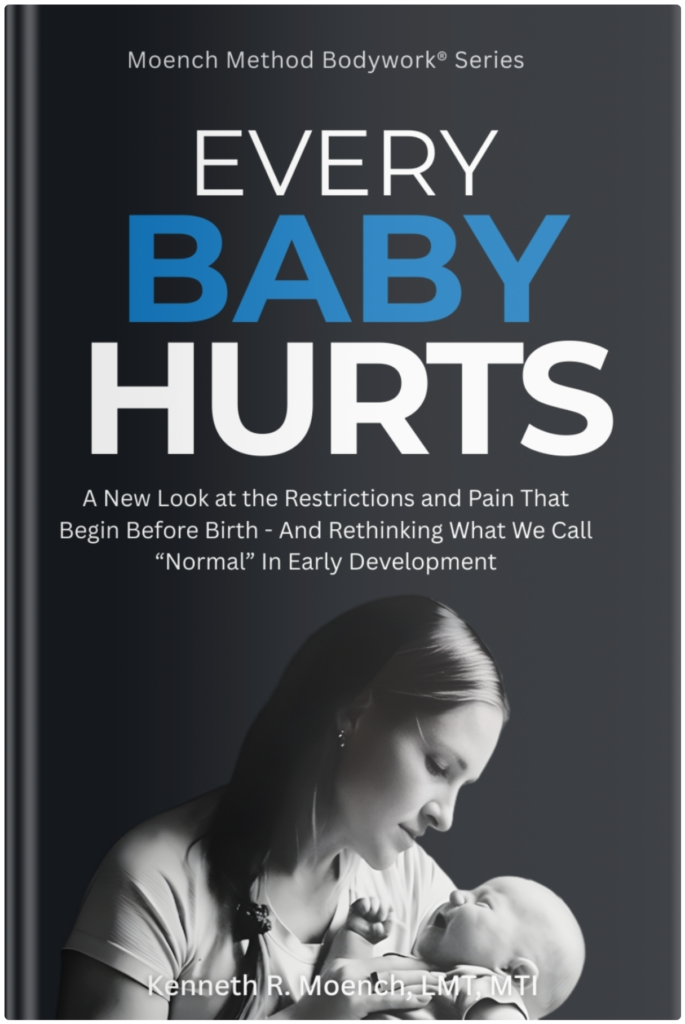
Seven chapters.
One uncomfortable truth.
For fifty years we’ve handed exhausted parents the same words — and the same shrug. They are not answers. They are placeholders for a problem no one was trained to find. The crying is real. The pain is real. And it has a source.
After thirty years and 50,000 patients, Ken Moench is saying it plainly: that crying is pain — measurable tension locked into a baby’s fascia from how they were positioned in the womb. It can be released.
But crying isn’t the only sign.
Even babies who aren’t constantly crying can struggle with discomfort. Many show it in quieter ways — through difficulty feeding, sleeping, movement, or tension in their bodies. You might be noticing:
- Difficulty feeding or latching
- Reflux-like symptoms
- Trouble settling or staying asleep
- Strong preference for one side
- Stiffness in the neck, hips, or body
- Tension when being held or laid down

What if your baby isn’t “colicky" "fussy" or "needy" — but hurting?
In our experience, many of the symptoms parents worry about aren’t behavioral, random, or "just a phase" but physical restriction or pain.
Babies spend months developing in confined positions before birth, and those positions can leave muscles tight and restricted. When that tension isn’t released, it can affect how a baby moves, feeds, sleeps, and settles.
How We Help Your Baby Feel Comfortable in Their Body
Babies go through a lot before they ever take their first breath. Time in the womb and the process of birth itself can leave muscles tight, contracted, or restricted — even when everything else looks “normal.” Moench Method Bodywork® uses precise, hands-on bodywork to gently release that tension so a baby’s body can finally relax, settle, and feel safe.

Real Parents. Real Results
From the very beginning, the results were noticeable. Immediately after our session with Ken, my son’s breastfeeding latch improved dramatically. As he grew, we began to notice that he was learning and absorbing the world around him in a way that felt far beyond his age. They say babies who experience Ken’s method absorb the world more easily, and I’m here to tell you: it’s absolutely true. I fully believe that having Ken work on my son as an infant set the foundation for the way he learns, processes, and engages with everything around him.
I was referred to Moench Method when my 7 month old suffered a pretty nasty fall. I had gone to urgent care, his pediatrician, and they both said that nothing was broken and he was fine. However, my baby was obviously still in pain and was no longer rolling over or sitting up without screaming. Ken was able to squeeze him into the schedule the very next day at the Westlake site and work on him. By the end of the session, my little guy was falling asleep. I scheduled two follow up appointments at the Round Rock location as Ken had recommended and now my baby is fully mobile again. Would definitely recommend!
Got a question?
Frequently Asked Questions
What exactly is the Moench Method for babies?
The Moench Method is a specialized, hands-on approach to releasing tight muscles and fascia that often develop before birth. It is not massage, chiropractic care, or physical therapy. Instead, it is precise soft tissue work designed to restore natural movement where a baby’s body has been restricted.
Many babies develop tightness in the womb due to their position or limited space. That tightness does not automatically resolve at birth. When it remains, it can contribute to discomfort, crying, feeding issues, poor sleep, or restricted movement. This method addresses the source of that tension rather than masking symptoms.
What does a session look like?
During a session, your baby lies comfortably on a table while the practitioner observes posture and movement. We gently assess areas like the hips, neck, shoulders, back, and jaw, paying close attention to where tension is being held.
Using sustained, intentional pressure with the fingers or hand, we work directly with tight muscle groups. We are not forcing movement or making adjustments. We are listening to the body and allowing it to release at its own pace.
Many parents notice visible changes during the session itself.
Will my baby cry during treatment?
Sometimes, yes. Crying is common during a release, not because the baby is being harmed, but because it is the only way their nervous system can express discomfort.
Parents often notice the cry change. It may begin sharp, then soften, and finally end with a deep breath or sigh. That moment usually signals that the tension has released.
Crying during treatment is short-lived, and once the release happens, babies often relax deeply, stretch out, or fall asleep.
Is this safe for babies?
Yes. The Moench Method has been adapted specifically for infants and has been used with babies for many years. The work is gentle, controlled, and intentional.
Discomfort is not the same as danger. Much like a deep stretch, the sensation can be uncomfortable while it’s happening, but the goal is relief — not endurance. Parents are present the entire time and can observe every step of the process.
We always prioritize safety, consent, and the baby’s nervous system throughout treatment.
What should we expect after a session?
Many babies sleep deeply after their first session. Others may be temporarily tired or slightly fussy as their body adjusts. These responses are normal.
Most parents report noticeable changes such as:
• Improved sleep
• Easier feeding
• Less crying
• More relaxed posture
• Increased movement and comfort
Some babies experience dramatic improvement after one session. Others may need two or three visits to fully unwind longer-held patterns. The changes tend to last because the underlying tension has been addressed.


