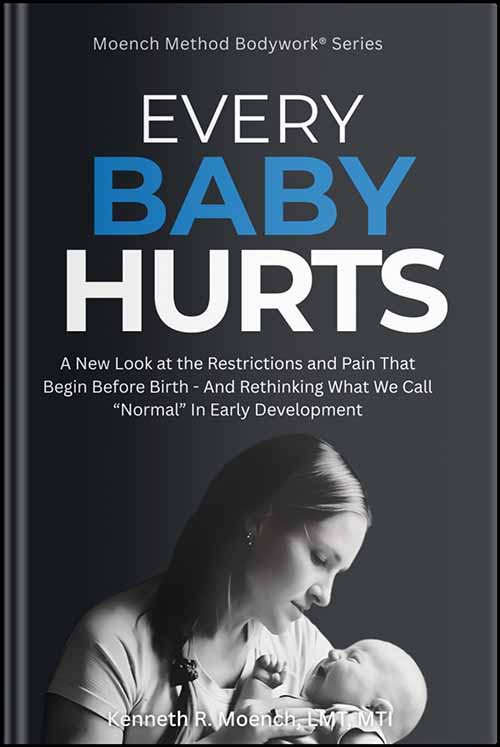

By Kenneth R. Moench, LMT, MTI
Founder, Moench Method Bodywork | Author of Every Baby Hurts
Every parent knows the sound. A baby begins crying, and immediately the questions start. Are they hungry? Tired? Too hot? Too cold? Do they need a diaper change? Are they uncomfortable? Or do they simply need to be held?
Sometimes the answer is obvious. Other times, you've fed your baby, changed their diaper, rocked them, walked the floor, and tried everything you can think of. And they're still crying.
I'm the father of four children. My wife and I experienced approximately two years of disrupted sleep with each one. We were exhausted, just like countless other parents. And despite spending my professional life helping people with pain and physical restrictions, I never considered whether some of our babies' distress might involve physical discomfort that wasn't immediately obvious. I simply accepted the sleepless nights as part of raising children.
It wasn't until I became a grandfather that something happened to change my perspective.
The Grandson Who Opened My Eyes
My grandson Austin was having a difficult time. At just three weeks old, he was crying frequently and struggling to settle. Watching him struggle, I began wondering whether some of the physical restrictions I'd spent decades addressing in adults might also be present in newborns. It was a possibility I'd never seriously considered before.
I decided to explore it. After working with Austin, his family reported noticeable improvements in his comfort and sleep. That experience raised an intriguing question: Could physical discomfort sometimes contribute to the crying and sleep difficulties that parents have been told are simply normal parts of infancy?
I didn't have an answer. But I was curious. And then Austin's little sister was born.
The Baby Who Seemed Perfectly Fine
When my granddaughter Calla arrived, she appeared to have none of the difficulties we'd seen with her brother. She wasn't showing the same distress. There was no obvious reason to suspect anything was wrong.
But my daughter Lauren remembered how difficult life had been with Austin. Now she had a 20-month-old toddler and a newborn to care for. She couldn't imagine going through those exhausting months again if Calla developed the same difficulties. So Lauren insisted that I work with her.
Calla was just 36 hours old. I wasn't expecting to find much. What I discovered shocked me.
As I gently examined Calla, I encountered what felt to me like substantial tightness and restrictions in her soft tissues. My impression was that she was even more restricted than Austin had been. Yet she appeared perfectly content. During the session, she relaxed and fell asleep.
And I was left with a question I couldn't shake: If a baby who seemed completely comfortable could have the degree of restriction I believed I was feeling, what might we be overlooking in other infants?
It's important to recognize that tightness perceived through touch does not necessarily mean a baby is experiencing pain or has a medical problem. But that experience changed the direction of my work. Austin had opened my eyes to a possibility I'd never considered. Calla inspired me to investigate it more thoroughly. That session ultimately led me to write Every Baby Hurts.
Crying Is a Baby's First Language
Babies don't arrive in this world with the ability to explain what's happening inside their bodies. They can't tell us they're hungry, their stomach hurts, their neck feels uncomfortable, or they're struggling to settle into a comfortable position. Instead, they communicate through crying, facial expressions, movement, and changes in behavior.
Crying is a normal part of infant development. Healthy newborns often experience a period of increased crying during their first few months, commonly peaking around six to eight weeks before gradually decreasing. Not every cry indicates pain, and not every crying episode has an identifiable cause.
But that doesn't mean we should stop being curious. When a baby repeatedly seems uncomfortable, I believe it's worth asking what might be contributing to that discomfort.
What Are the Common Reasons Babies Cry?
There are many well-recognized reasons for infant crying. Hunger, fatigue, wet diapers, temperature, overstimulation, and the need for comfort or closeness are among the most common. Some babies experience feeding difficulties, reflux, constipation, or other medical conditions that contribute to distress. And sometimes babies cry even when all their apparent needs have been met.
Persistent or unusual crying should be discussed with a pediatric healthcare professional, particularly when accompanied by feeding problems, fever, vomiting, poor weight gain, unusual sleepiness, or changes in behavior.
But there's another area I've become particularly interested in over the years. Could a baby's physical comfort and freedom of movement also influence how easily they settle?
What About the Position Babies Spend Months in Before Birth?
Think about the environment a baby experiences during pregnancy. For months, the developing baby grows within the limited space of the uterus. As pregnancy progresses, the baby's available space and range of movement change. Their head, neck, shoulders, arms, hips, and legs may spend extended periods in flexed or rotated positions.
Most babies adapt normally to these conditions, and their bodies continue developing after birth. But fetal positioning can sometimes influence newborn posture and movement. Recognized examples include certain positional head preferences and musculoskeletal conditions.
This led me to a question that has fascinated me for years: Could some babies emerge from pregnancy with soft-tissue restrictions or movement sensitivities that contribute to physical discomfort?
I use the term Pre-Birth Postural Deficits, or PBPD, to describe a pattern of restrictions I've observed in my infant bodywork practice. PBPD is my proposed clinical concept, not an established medical diagnosis. Research has not yet determined whether the patterns I describe constitute a distinct condition or cause persistent infant discomfort. Nevertheless, my observations have encouraged me to keep asking questions.
What I've Observed Working With Infants
When I began working with newborns, I was struck by how differently individual babies responded to gentle touch and positioning. Some appeared comfortable moving their heads in either direction. Others seemed to prefer turning toward one side. Some tolerated diaper changes and handling easily, while others became upset during certain movements. I also observed areas that seemed unusually sensitive or resistant to movement.
In some cases, parents reported that their babies appeared calmer, slept longer, or tolerated handling more comfortably following sessions. These experiences made a lasting impression on me.
But I want to emphasize an important distinction. An improvement observed after treatment does not, by itself, prove that the treatment caused the improvement. Babies change rapidly. Their feeding, sleep, digestion, and behavior naturally fluctuate.
That's why I believe systematic research is so important. I would like to see carefully designed studies examining whether the movement patterns and soft-tissue findings I've observed are reproducible, whether they correlate with measurable discomfort, and whether appropriate interventions produce benefits beyond normal developmental changes.
Could Physical Discomfort Affect Sleep?
Anyone who has cared for a newborn knows how precious sleep can become. And when a baby struggles to settle, the effects can extend throughout the household. Parents may become exhausted. Relationships can become strained. Even ordinary daily responsibilities may feel overwhelming.
Infant sleep is influenced by many factors, including age, feeding, circadian development, temperament, and health. Physical discomfort can also interfere with sleep in some circumstances. What remains uncertain is whether the particular soft-tissue restrictions I've observed contribute meaningfully to sleep difficulties in otherwise healthy infants.
This is one of the questions I would most like to investigate through research. Imagine being able to measure sleep duration and quality before and after an intervention, compare those findings with an appropriate control group, and determine whether any improvements are meaningful. That's the kind of evidence that could help us move beyond individual observations toward a better understanding of infant comfort.
What Should Parents Watch For?
Parents often notice subtle differences in their babies before anyone else does. Perhaps your baby consistently prefers looking in one direction. Maybe they become distressed during certain movements or positions. Perhaps feeding is easier on one side than the other. Or you may notice that they seem unusually uncomfortable during routine handling. These observations can be useful to share with your pediatrician.
Some patterns, such as a persistent head-turning preference or difficulty moving the neck, may warrant evaluation for conditions such as congenital muscular torticollis. Feeding difficulties may benefit from assessment by a pediatrician or qualified lactation professional.
It's important not to assume that every preference, asymmetry, or crying episode indicates a soft-tissue restriction. And parents should never attempt forceful stretching, neck manipulation, or deep-pressure techniques on an infant. If hands-on treatment is being considered, it should be discussed with the baby's healthcare professional and performed only by someone appropriately trained in infant care.
What Does Gentle Infant Bodywork Involve?
My approach to infant bodywork grew out of decades of working with adults experiencing pain and movement limitations. Over time, I began exploring whether some of the principles I'd developed could be adapted to the very different needs of newborns.
Infants require an exceptionally gentle approach. Their tissues, nervous systems, and developing bodies are not simply smaller versions of an adult's. My focus is on observing comfort, movement, and responses to gentle contact, while respecting the baby's cues and limits. The goal is never to force movement or push through distress.
And it's important to acknowledge that the effectiveness and safety of my specific approach for improving infant sleep, crying, or feeding have not yet been established through rigorous clinical trials. I hope that future research will help clarify where, if anywhere, this type of care may have an appropriate role alongside established pediatric care.
Parents Deserve Support, Not Blame
There's something else I want every parent to understand. A crying baby is not a sign that you're doing something wrong. Some babies are simply more difficult to soothe than others. And sometimes, even loving, attentive parents cannot identify why their baby is upset.
If you're exhausted or overwhelmed, it's okay to ask for help. If you need a moment to regain your composure, place your baby on their back in a safe crib or bassinet and step away briefly. Never shake a baby. And remember that you don't have to solve every difficult moment alone.
One of my greatest hopes is that by learning more about infant comfort, we can also help families experience less stress and greater confidence during those challenging early months.
Every Baby Has a Story
After years of working with infants, I've become convinced of one thing: We should never stop listening to what babies may be communicating through their behavior and movement.
Sometimes the answer is hunger. Sometimes it's fatigue. Sometimes it's a need for closeness. Sometimes a medical condition requires attention. And perhaps, in some cases, physical movement restrictions deserve closer investigation.
We don't yet have all the answers. But I believe asking thoughtful questions, listening to parents, and pursuing careful scientific research can help us understand babies better.
Because every baby has a story. And every baby deserves to be heard.
About the Author
Kenneth R. Moench, LMT, MTI, is the founder of Moench Method Bodywork, a Central Texas practice specializing in hands-on approaches to soft-tissue restrictions and movement limitations. Licensed in 1993, Ken has spent more than three decades working with clients of all ages, including over a decade exploring infant movement and comfort. He is the author of Every Baby Hurts, a book examining his observations and questions about physical discomfort beginning before birth.